
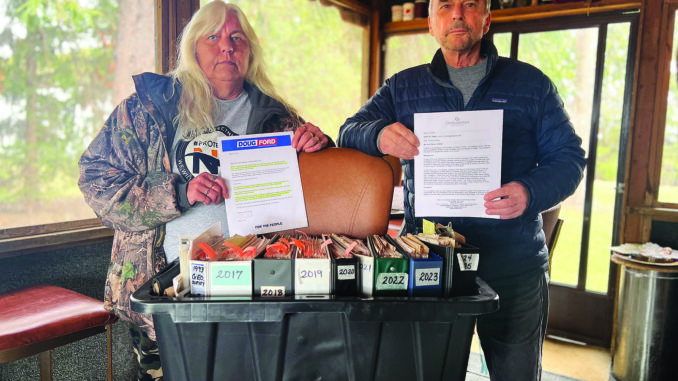
By: Pam Wright, Local Journalism Initiative Reporter, Chatham Voice
The well of hope has run dry for North Kent residents worried about the health effects of heavy metals in black well water.
Earlier this month Ontario’s Ombudsman issued a letter stating the Ministry of Health won’t be going forward with a health hazard study on the “bio-accessibility” of potentially toxic sediment in the affected wells as requested.
In addition, the MOH has taken the same position in response to a 1,400-signature petition submitted to the Ontario legislature in June 2025, asking the government to probe the bio-accessibility issue.
Christine Burke, whose well has been fouled since nearby wind turbines took shape in 2014, said the Ford government has abandoned affected residents.
“They shut the door on the people,” a frustrated Burke told The Voice after receiving the news. “They shut the door on families and they’ve turned their backs on the people.”
Local geologist Keith Benn, who sat as an expert witness on the all-hazard study carried out by the province in 2021, describes the government’s response as “industrial-strength gaslighting” noting officials neglected testing the sediment as requested.
“This is rock-solid proof the government is ignoring the issue and the petition,” Benn said in an interview. “We made it known that the bio-accessibility of toxic metals in the sediment was the main concern, but the sediment was never tested.
“Testing the sediment was the main thing we asked for,” Benn stressed.
Dirty water said to be caused by the construction and operation of wind turbine farms in North Kent has been a contentious issue in Chatham-Kent for more than a decade. Residents in the Dover/Mitchell’s Bay area and Chatham Township began complaining of fouled water in their wells when industrial wind farms appeared on the landscape. Many of the affected homeowners said their well water turned murky and black, clogging pumps and filters and making it unfit to use and drink.
For some, the problem continues to this day.
Geological studies have determined the industrial turbines have been built on an aquifer comprised of Kettle Point Black Shale known to carry toxic metals.
Burke, with the help of Benn and Wallaceburg Area Wind Concerns, brought the matter to Doug Ford’s attention when he was on the campaign trail in 2018. In a face-to-face meeting at a Wallaceburg coffee shop, Ford said he was going to address the issue.
After he was elected, Ford did halt the construction of the Otter Creek Wind Farm north of Wallaceburg. He also spearheaded an all-hazard study of dirty water wells located in the shadow of the North Kent 1 Wind Farm.
But at the time, no testing was done on affected properties in Dover. In that area, where Burke lives, no attempt was made, and the problem continues unabated. She and husband Terry have installed a complex filtration system, but the couple remain worried about the bio-accessibility of toxic metals.
The North Kent 1 Wind Farm consists of 34 wind turbines, and the East Lake St. Clair Wind Farm near Mitchell’s Bay has 55 turbines in operation. There are another five turbines operated by Boralex on Marsh Line in Dover.
To prove their point and push the government to find a solution, local residents raised $12,000 in 2023 to pay for independent testing at a Michigan laboratory. A professional hydrogeologist sampled nine wells. The tests detected levels of arsenic, barium, cadmium, cobalt, nickel and lead. Mercury was found in two wells.
But the discovery didn’t result in any action by the province.
Burke said she’s also worried about families who unknowingly purchase properties with fouled wells, adding one of her new neighbour’s dogs was getting sick after consuming the water. The family wasn’t aware of the problem when they purchased the home.
At the Grace Congregational Church on Bear Line, the water also contains black sediment, Burke said.
“They’re serving coffee and tea and everything there,” she added.
Benn also points out that wells may contain the toxic heavy metals even if the water may appear clear and could be harmful to human health if ingested.
As part of its response, the MOH has instructed well owners to take advantage of free water testing for E. coli. and other bacteria through Chatham-Kent Public Health.
But Burke and Benn both said that’s not the answer.
