
By: Pam Wright, Local Journalism Initiative Reporter, Chatham Voice
Cutting-edge technology is transforming health care at the Chatham-Kent Health Alliance one sample at a time.
That’s thanks to a $1 million upgrade in the hospital’s laboratory.
Two new chemistry analyzers are at the heart of the refresh – bringing pinpoint accuracy to the testing of blood and body fluids.
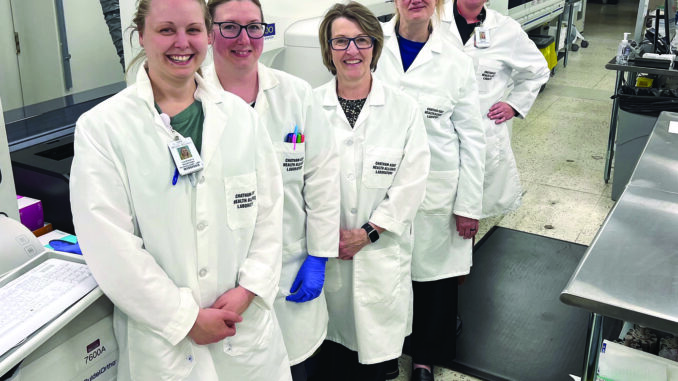
Reporters were treated to a look at the Quidel Ortho Vitros 7600 machines last week, as well the adjacent track automation line. Behind stainless steel and plexiglass, the robotic mechanisms whir, ferrying tubes of liquid from one end of the unit to another.
In describing the process, CKHA laboratory services manager Mary Poulin says the technology cuts man hours and enhances patient care.
“Eighty-five per cent of a doctor’s diagnosis, or a clinician’s diagnosis for our patients is based on the lab results that we provide every single day,” Poulin said. “Prior to the automation line being installed, our team was manually uncapping and recapping 300 to 500 samples every single day.”
According to Poulin, the system runs entirely on barcodes, allowing technicians to locate and retest samples swiftly.
Samples the machine deems normal are handled entirely through automation, enabling staff to focus on the samples that need a closer look.
“That means our technologists are focused more on quality and patient safety,” Poulin explained, adding a patient’s journey is akin to an old-fashioned wagon wheel.
“The patient is at the centre of that wheel,” she said. “We’re one of the many spokes that allow that patient journey to go around.”
The new technology replaces CKHA chemistry platforms that were 12 years old. Machines that are becoming outdated are described as “sunsetting” – meaning they can no longer be serviced due to outdated technology. Poulin said the hematology stainer – a critical diagnostic tool – is sunsetting at the end of 2026, so replacing it is on the agenda.
Safety and patient identification are key, and, according to diagnostic services director Jolene Kresan, the lab has 1,100 policies in place to make sure nothing goes awry.
“We follow rules to keep people safe,” Kresan explained. “We have government standards that we have to meet. We need 100-per-cent accuracy here.”
The new CKHA system, referred to as “dry” chemistry, was developed in collaboration with Bluewater Health in Sarnia. Four staff, including chemistry charge technologist Dayna Houle, underwent intensive training on the analyzers in Rochester, N.Y. In turn they relayed that information to the rest of staff.
Reading results isn’t the only thing staff at the lab do, Kresan noted, as some of them are getting under the hood fixing the machines.
Along with chemistry testing, the CKHA laboratory also houses transfusion medicine; histology (the examination of tissue) and hematology. There are 55 staff providing laboratory services including pathologist Dr. Jason Back.
CKHA president and CEO Adam Topp thinks the public is interested in what happens behind the curtain.
“It’s exciting for us; we think it will be exciting for other people to learn about, but it’s not something that would be the first thing you would ask about,” Topp said, adding the hospital plans on providing more behind-the-scenes information in the future.
“Jolene and Mary and her team have done some amazing work,” Topp said. “And I really wanted to give them a chance to just show off.”
The unveiling coincides with Medical Laboratory Professionals Week April 12-18 – aimed at marking the work of those who toil in laboratories behind the scenes.
The Quidel Ortho Vitros 7600 chemical analyzers became operational last August, followed by the automated track line Sept. 30. April 1 of this year marked the launch of auto verification software.
