
By: Pam Wright, Local Journalism Initiative Reporter, Chatham Voice
For enslaved people in the United States 150 years ago, New Year’s Day was no cause for celebration.
Instead, in pre-Civil War America, Jan. 1 was deemed “Heartbreak Day” – the date when plantation owners would sell or rent slaves in order to balance the books for the calendar year.
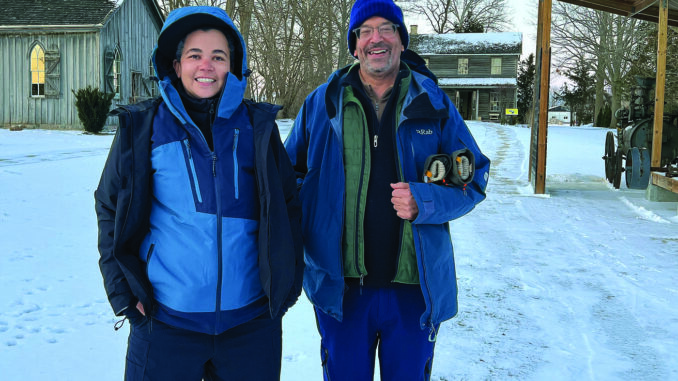
Heartbreak Day is one of the reasons activist walker Ken Johnston embarked on his 120-km. Freedman’s Journey from Detroit to Dresden in the dead of winter.
“It’s to recall and remember that freedom seekers had no choice when they had to leave,” Johnston told The Voice in an interview at the Josiah Henson Museum of African-Canadian History in Dresden where he finished his journey Jan. 2.
“It’s to remember those who sought freedom in the winter months. That’s something everyone is able to relate to…they had to seek out freedom in the harsh winter months.”
Because slave owners sometimes allowed slaves to leave to visit family at other plantations, Johnston said freedom seekers chose the Christmas holidays as the time to “self-emancipate” so they could get ahead of patrols by a day or two before anyone noticed they were gone.
“A lot of slaves would be sold by their owners so they could end the year in the black,” he said. “It’s really a sad story.”
Johnston, a Black American from Philadelphia, started the Detroit to Dresden trek Dec. 26. The journey involved walking on backroads from Windsor via Amherstburg, Tilbury, Buxton and Chatham. Johnston headquartered in Chatham courtesy of the Comfort Inn and completed sections of his walk over a few days.
On his journey, he visited the Buxton Historic Site and Museum; the Chatham-Kent Black Historical Society and Black Mecca Museum in Chatham; as well as the Josiah Henson site. At each location, he was met with supporters and the descendants of enslaved people who joined him on his mission.
One of staunch supporters is Hamilton resident Moe Knaus, who has joined Johnston on all of his Canadian walks. Knaus, 39, who has historical family ties to Chatham-Kent, said she feels “connected” to all of the local sites the pair visited.
“My family’s from here and I live in Hamilton so this has been a homecoming for me,” Knaus said.
Johnston’s recent foray marks the third time the 65-year-old has headed to Canada to complete a walk to raise awareness about the many paths Black freedom seekers took on the Underground Railroad. Last summer, he trekked from Niagara Falls to Owen Sound to mark the community’s 163rd Emancipation Day, pausing along the way at some of the locations that were safe havens for travellers on the Underground Railroad.
In 2022, Johnston walked from Harlem N.Y. to St. Catharines, completing a journey that began in Maryland in 2019, where he traced the footsteps of renowned abolitionist Harriet Tubman and other freedom seekers.
Johnston has completed other significant walks. On his first journey in 2017, he accomplished a ‘Walk to Freedom’ in Massachusetts and after that he wanted more.
“It’s a calling for me,” he said. “If you want a taste of freedom, just keep going, and that’s what I’ve been doing.”
In 2018, Johnston marked the 50th anniversary of the assassination of civil rights activist Dr. Martin Luther King by walking 400 miles (640 km.) from Selma Alabama to the National Civil Rights Museum in Memphis, Tenn. – the city where King was assassinated.
Going forward, Johnston said has no plans to put away his walking shoes.
“I want the public to be aware of the Canadian institutions that are here so everyone can learn about them,” he said, noting First Nations, African and European cultures intersected at terminus of the Underground Railroad.
“The story is that African Americans escaped to Canada and the story ends there,” he said. “But really, the story is just beginning.”
