
By: Pam Wright, Local Journalism Initiative Reporter, Chatham Voice
A tiny non-descript caterpillar may hold the key to controlling the catastrophic spread of phragmites australis.
Commonly referred to as “phrags,” the towering plants have been dubbed Canada’s “most invasive species” and their spread threatens critical wetland habitat and species at risk.
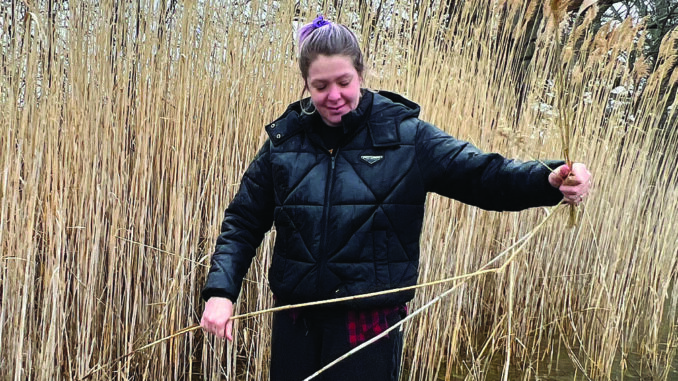
But researchers are fighting back. One of them is University of Waterloo PhD candidate Claire Schon, who has been studying the plant for four years. Recently, she spoke to members of NatureCK in a presentation at the Chatham-Kent Public Library.
In addition to outlining the devastating effects of phragmites, Schon described how progress is being made to control the plant through bio-control.
“We lose a lot of the plant biodiversity because of phragmites and it has a lot of negative impacts on birds and amphibians,” Schon explained, noting the plant’s out-of-control growth accelerates the release of carbon into the atmosphere.
“One in four species at risk in Ontario are directly threatened by phragmites invasion,” Schon told the crowd. “It really doesn’t discriminate on what kind of animals it harms – it has impacts on the entire ecosystem.”
Also known as the European common reed, invasive phragmites are believed to have arrived in Canada in ship ballast near Halifax around 1910, arriving in Ontario in 1948. In the early 2000s it was documented in the western provinces – making it a problem nationwide.
The tall wetland grass – reaching as high as five metres – chokes out existing wetland flora and fauna, altering every ecosystem where it takes root.
Schon said phragmites have negative societal and economic impacts as well, noting the plant can affect agricultural drainage and lower values at waterfront properties. It can also be a traffic hazard blocking views at intersections and ruining recreational waterfront activities such as kayaking. Dry stands of the plant pose a significant fire hazard.
“Phragmites control is a really hot topic in Ontario,” Schon added, noting the province committed $11 million to battling the plant in 2025.
In a 2021 cost benefit analysis, the researcher said that controlling phragmites would have resulted in $113 million worth of benefits to Ontario.
“It’s good for the marshes, but it’s also good for the bottom line to control phragmites,” Schon explained.
Traditionally, control has hinged on expensive chemical herbicides, sometimes using planes or drones, or mechanical control – cutting the plant below the waterline to kill it by drowning the rhizome – the plant’s horizontal stem.
On a smaller scale, people “spade” the plant, using a shovel to cut the stem from the rhizome.
Because of the enormity of the problem, Schon said it’s important to find a solution.
Development of biological control for phragmites began in 1998, Schon said, noting researchers studied insects that feed exclusively on phragmites in Europe.
Two “stem-boring” moth species were selected for study in Canada after 11 years of research in North America. The insects lay their eggs in early spring. When hatched, the caterpillars bore into the stem of the phragmites plant, consuming two-to-four stems before pupating. The resulting moths lay their eggs in late summer and these survive over the winter.
“The goal is not to completely get rid of it (phragmites) but to bring it to a level that’s manageable,” Schon told the crowd.
In 2019, the federal government approved the use of the moths and it’s been full steam ahead since. A Ducks Unlimited wetland at St. Luke’s Marsh, adjacent to St. Clair National Wildlife Area near Pain Court, is one of 60 sites in Ontario being studied. Schon is monitoring 12 sites from Windsor to North Bay.
In 2025, out of 35 plots where the moths were released, the insects survived and expanded their range in 25 of the sites.
“In general, they are increasing at most of the sites,” Schon said. “Biological control is really a gentle, gradual approach. Quantifying these changes is really hard because sometimes it takes decades to see the changes.”
A reduction in height and biomass and a decrease in the number of live stems to allow more light to penetrate through the canopy are two of the benefits researchers have observed to date.
“The moths are doing their job and we have some early-on signs of success,” Schon said, noting the moths are proving to be “very resilient” as they survived a fire that destroyed one of her test sites.
If an individual property owner wants to attack phragmites, Schon advises it’s important to distinguish the invasive European species from the native North American species.
