
By: Pam Wright, Local Journalism Initiative Reporter, Chatham Voice
As industry grapples with the fallout from Trump’s tariffs and war in Iran, officials at home continue to push for change.
To that end, Chatham-Kent–Leamington MP Dave Epp would like to see the federal government reduce regulatory red tape and spell out the rules of the trade game.
Business needs stability, Epp said.
“The theme I’m hearing from across all of business is that business does not like uncertainty,” Epp told The Voice during a recent stop at Maple Industries in Chatham. “Whatever shall be, shall be, and we can live with that. Tell us what the ‘shall be’ is, and then we can reorganize…we can orientate.”
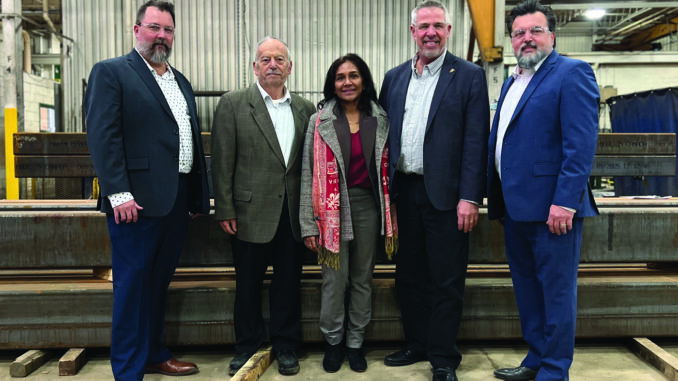
Recently, Epp met with local industry leaders, including those in the steel and aluminum manufacturing, sectors hard hit by punishing American tariffs. That includes the Maple facility on Sass Road, which has seen its 50-person workforce cut this past year because of tariffs.
Bill Munns, the company’s general manager, said the government needs to promote the domestic procurement of steel; find ways to give business relief from the tariffs and speed up the regulatory process.
Currently, Canada does not have capacity to produce what are referred to as “I-beams,” Munns said, which are a key component in the construction industry. In the past Mexico, Canada and the United States worked together, with the I-beams coming from the U.S. but tariffs have made that too costly. Now the I-beams come from countries such as Turkey, Vietnam and China.
“If we can’t access them, we can’t build,” Munn stressed. “The tariffs have created a lot of insecurities across the board so that’s why you haven’t seen a lot of private investment.”
Time is of the essence when it comes to the tariff issue, Munns added, because there’s nothing “cheaper than today.”
Domenic and Paolo Colucci purchased Maple Industries Ltd. in 2004. They said they are looking for help to stabilize the business and hope to expand in new areas, such as defence.
“We’re challenged now to see if we can make some new connections,” Paolo told The Voice. “There’s some deep roots here in the Chatham-Kent area and a lot of people who have experience in this industry. We’re assembling a team of innovators. People are moving to Chatham-Kent; they want to be a part of what’s going on here.”
“We have a great opportunity with bright, young people in this country who will have a lasting impact,” he added.
Canadian Institute of Steel Construction’s Suja John, also on hand at the meeting, said ensuring domestic steel is used in upcoming government projects is a goal.
“”If we can keep the infrastructure in government-funded projects, we can sort of make up for the jobs that we’ve lost,” the CISC business initiatives manager said, noting some 5,000 jobs are gone because of tariffs on steel.
“If we can keep it within Canada, our members can do it,” John said.
Epp, who has spent a large part of his career in the agri-food business, said removing barriers on steel through regulatory reform is essential.
One of the barriers introduced on April 1 is a spike in the industrial carbon tax to $110 a ton, which Epp said is embedded in the cost of steel, cement and fertilizer.
“We had an election a year ago under the promise that we would know the rules by last July,” Epp told reporters. “People don’t know what the rules are. We live in chaotic times.”
Epp’s words come on the heels of Conservative leader Pierre Poilievre’s recent trip to the United States where he hit the podcast circuit lobbying on Canada’s behalf.
According to Epp, big-ticket infrastructure projects, such as an East-West pipeline are needed, adding the Conservatives voted to support the Liberal’s C5 bill which gives extraordinary powers to major federal projects.
But nothing’s happened yet, Epp added.
“We’re not seeing it,” the MP explained. “We have to get stronger at home. We have not done well with our own productivity because of the burdens we’ve self-imposed.
“The only people that can control Trump are the American people,” Epp concluded. “We have to be responsible for what we do ourselves, by lifting regulatory burdens and obstructions we put into place. That’s what we can control.”
